
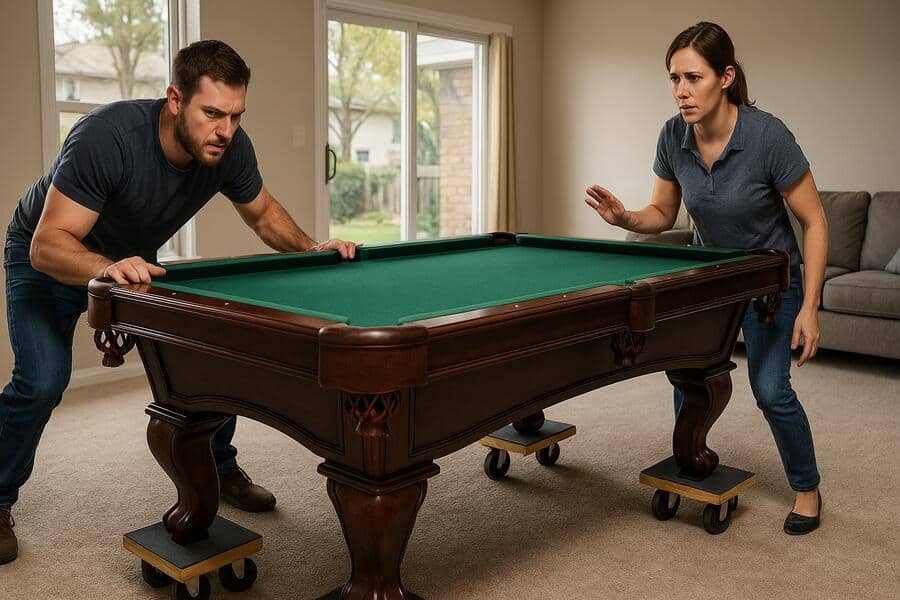
The thought of relocating a pool table often brings up a big question: “Can you move a pool table without taking it apart?” For most pool table owners, the answer is a resounding no, especially if it’s a slate table and you’re moving it more than a few feet. Attempting to move a fully assembled pool table, particularly one with a heavy slate playing surface, is extremely risky and can lead to irreversible damage to the table, your home, or even serious personal injury.
However, there are very specific and narrow cases where a “moving pool table in one piece” might be feasible for a “short distance pool table move” within the same room or an adjacent space. Understanding these exceptions and, more importantly, why disassembly is almost always required, is key to protecting your investment. For most situations, professional learn more about our services are not just recommended, but essential.
💡 Key Takeaway: Moving a pool table without disassembling it is generally not recommended, especially for slate tables and longer distances, due to high risks of damage and injury.
Why Disassembly Is Almost Always Necessary
1. The Fragility and Weight of Slate
The primary reason for disassembling a pool table is the slate. Most quality pool tables feature a playing surface made of one to three heavy slabs of slate. These slabs are extremely heavy and surprisingly fragile.
- Risk of Cracking: Moving an assembled slate table puts immense stress on the slate and its supporting frame. Any twisting, tilting, or uneven lifting can cause the slate to crack or warp. A cracked slate often means the table is irreparable.
- Extreme Weight: Each slab of slate can weigh between 150-250 pounds or more. Even a small 7-foot table can have three slabs totaling over 450 pounds. This weight, combined with the table’s awkward dimensions, makes it impossible to lift and maneuver safely as a single unit.
- Damage to Frame and Legs: The frame and legs of a pool table are designed to support the slate’s weight evenly when it’s stationary. Trying to lift and move the entire assembled table can cause the frame to twist, legs to bend or break, and joints to become compromised.
2. Precision Leveling and Structural Integrity
A pool table’s playing surface must be perfectly level for accurate gameplay. The way it’s constructed and transported directly impacts this precision.
- Shifting Slate: Even if you manage to move an assembled table without visible damage, the internal vibrations and minor shifts during transit can misalign the slate. This means the table will no longer be level, severely impacting play.
- Re-leveling Requirement: After any move (even a short one), a slate pool table almost always requires professional re-leveling using specialized tools like a machinist’s level. This process is far more difficult, if not impossible, if the slate hasn’t been properly re-seated and secured after disassembly.
- Manufacturers’ Recommendations: Most pool table manufacturers explicitly recommend full or partial disassembly for any move beyond a few feet. Ignoring these recommendations voids warranties and risks significant damage.
💡 Key Takeaway: Slate pool tables must be disassembled for relocation due to the slate’s fragility, extreme weight, and the risk of cracking. Maintaining precision leveling and structural integrity after a move is nearly impossible without professional disassembly and reassembly.
Exceptions and When a Short Move is Possible
3. Limited Scenarios for Moving in One Piece
While generally ill-advised, there are a few very specific situations where a “moving pool table in one piece” might be considered for a “short distance pool table move.”
- MDF or Non-Slate Tables: If your pool table has a playing surface made from MDF (medium-density fiberboard) or another material instead of slate, it will be significantly lighter and less fragile. These types of tables can sometimes be moved intact, especially if they are smaller. Always confirm the table’s construction material first.
- In-Room Shifting: If you only need to shift the table a very short distance within the same room (e.g., to clean behind it or adjust its position), and you have enough strong individuals (4-6 minimum, depending on table size), it might be possible to carefully lift and move it using furniture dollies. Ensure the path is perfectly clear and level, and lift evenly.
- Adjacent Room Move (Highly Risky): Moving an assembled slate table to an adjacent room, especially through a doorway, is extremely risky. It requires precise coordination, multiple strong movers, and perfectly clear, level pathways. Even then, the risk of damage to the table, floors, and walls remains high. Professionals typically won’t attempt this for slate tables.
4. The Disassembly Process and Why It’s Best Left to Pros
Professional pool table movers follow a specific, careful process to ensure the table’s integrity during relocation.
- Remove Pockets and Rails: The leather, plastic, or rubber pockets are removed, followed by the side rails. The rails are often indexed to ensure they return to their original positions.
- Remove Felt (Cloth): The felt is carefully un-stapled or un-glued from the slate and frame. This delicate material must be handled with care to avoid tears or stretching.
- Remove Slate: This is the most critical step. Each heavy slate slab is unbolted from the frame and carefully lifted and crated for transport. Slates must be transported flat, never on their side.
- Disassemble Frame and Legs: The frame and legs are then typically disassembled, packed, and transported.
- Reassembly and Leveling: At the new location, the process is reversed. The frame and legs are reassembled, the slate is meticulously reset, and new or existing felt is installed. Finally, and crucially, the table is professionally leveled using a machinist’s level to within a fraction of an inch, often 5/1000th of an inch per square foot.
Pool Table Moving Scenarios: DIY vs. Pro
| Scenario | Feasibility of Moving in One Piece | Recommendation |
|---|---|---|
| Slate Table, Long Distance (House-to-House) | No, impossible without severe damage. | Always hire professional pool table movers. |
| Slate Table, In-Room Shift (Few Feet) | Possible, but risky; requires many strong people & careful lifting. | DIY with extreme caution & help, or consider professional spot move. Re-leveling likely needed. |
| MDF/Non-Slate Table, Short Distance | More feasible, but still heavy. | DIY with proper equipment (dollies) and adequate help. Less risk of irreparable damage. |
| Any Table with Stairs or Tight Spaces | No, almost always requires full disassembly. | Always hire professional pool table movers. |
💡 Key Takeaway: Moving a pool table in one piece is only plausible for light, non-slate tables or minor in-room adjustments. For all other scenarios, especially involving slate, stairs, or new locations, professional disassembly, transport, reassembly, and expert leveling are non-negotiable.
Conclusion
The question of “can you move a pool table without taking it apart” is met with a strong recommendation for disassembly in nearly all cases, particularly for slate tables. The immense weight and delicate nature of the slate, coupled with the precision required for level play, make a full disassembly the only safe and reliable method for relocation. While a “short distance pool table move” of a non-slate table or a simple in-room shift might be possible with extreme care, it’s crucial to understand the high risks involved. For peace of mind and the preservation of your valuable investment, entrusting your pool table move to experienced professionals is almost always the wisest choice.
Have questions about how to move pool table without disassembling? Reach out to our team today.
Frequently Asked Questions About Moving a Pool Table
What is the biggest risk of trying to move a slate pool table assembled?
The biggest risk is cracking the slate. Slate is heavy but brittle. Any uneven lifting, twisting, or impact during movement can cause it to crack, rendering the playing surface irreparable and effectively ruining the table. There’s also a significant risk of personal injury due to the extreme weight.
How much does a slate pool table typically weigh?
The weight of a slate pool table varies significantly by size, but generally:
- 7-foot table: 700-900 lbs
- 8-foot table: 800-1000 lbs
- 9-foot table: 1000-1200+ lbs
These weights include the frame, legs, and especially the heavy slate slabs.
Why is professional re-leveling so important after a pool table move?
Professional re-leveling is critical because even minor imperfections in the playing surface can drastically affect the game. Transit vibrations or slight variations in floor surfaces at the new location can cause the slate to shift. Professionals use highly accurate machinist’s levels to ensure the table is perfectly horizontal, allowing balls to roll true.
Can I move a pool table with a one-piece slate without disassembling?
Moving a pool table with a one-piece slate is even more challenging and dangerous than a three-piece slate. The single slab is immensely heavy and unwieldy. While theoretically possible for a very short, perfectly straight slide, the risk of cracking the slate or injuring yourself is extraordinarily high. Full professional disassembly is almost always recommended for any move beyond a few feet, even with a one-piece slate, to ensure safety and prevent damage.

