
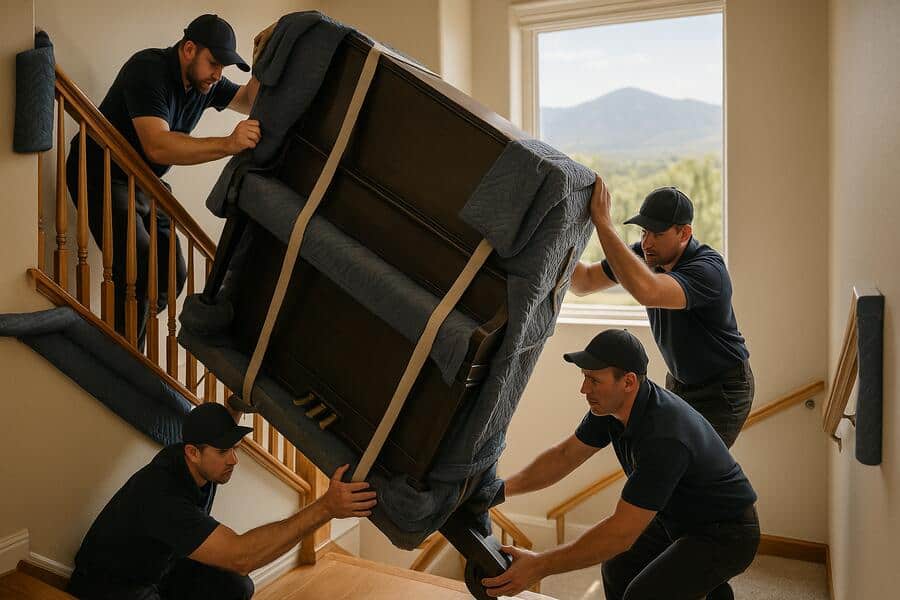
A piano is more than just a musical instrument; it’s often a cherished heirloom, a significant investment, and an incredibly heavy, delicate piece of furniture. The challenge of moving one is substantial, but when stairs are involved, the task transforms into a high-stakes operation. Attempting “moving a piano down stairs” or up them without specialized expertise and equipment can lead to severe injury, irreparable damage to the piano, or structural damage to your home.
The intricate mechanics, immense weight, and awkward dimensions of a piano demand precision and a methodical approach. This guide will explain why “piano stairs moving” requires a professional crew, detailing the specialized equipment used, the critical role of pre-move measurements, and the strategic positioning essential for safely transporting a “piano on stairs.” When you’re ready to tackle this complex move, rely on experienced piano movers denver who understand the nuances of this delicate task.
💡 Key Takeaway: “Moving a piano down stairs” or up is extremely challenging due to its weight, fragility, and awkward size, carrying significant risks of injury or damage. Professional expertise, specialized equipment, and careful planning are non-negotiable for a safe move.
The Unique Challenges of Piano Stair Moves
1. Essential Equipment for Piano Stairs Moving
Standard moving equipment is simply inadequate for the weight and delicate nature of a piano. Professional “piano movers” rely on specialized tools designed for this exact challenge.
- Piano Board (Skid Board): This is a padded, heavy-duty wooden or metal board specifically designed to secure an upright piano. The piano is strapped tightly to this board, which provides a stable, flat base for maneuvering and protects the piano’s finish.
- Heavy-Duty Straps and Ratchets: Industrial-grade ratchet straps are used to firmly secure the piano to the piano board, preventing any movement during the lift and transit.
- Piano Dollies: These are low-profile, multi-wheeled platforms with high weight capacities, used to roll the piano on flat surfaces. They are distinct from stair-climbing equipment.
- Stair-Climbing Equipment: For “piano on stairs,” professionals may use specialized stair-climbing hand trucks or motorized stair-climbing dollies that can “walk” the piano up or down steps. Alternatively, they might use sturdy, non-slip ramps or a combination of specialized mats and coordinated lifting techniques.
- Protective Padding and Covers: Thick moving blankets and custom-fitted transit covers are used to protect the piano’s finish from scratches, bumps, and environmental changes.
2. Pre-Move Assessment: Measurements and Path Planning
The first and most critical step for any “piano stairs moving” job is a meticulous assessment of both the piano and its environment. Encouraging measuring before booking is vital.
- Piano Dimensions: The piano’s exact height, width, and depth (including any protrusions) are measured. For grand pianos, legs, pedals (lyre), and music stands are typically removed and wrapped separately, reducing its footprint.
- Staircase Dimensions: Every aspect of the stairs is measured:
- Width: The clear width of the staircase, from wall to banister, is measured. This is crucial for determining if the piano can be carried straight or if tilting is required.
- Tread Depth and Riser Height: These measurements help gauge the angle and stability of the steps.
- Landings and Turns: This is often the trickiest part. The size of any landings and the tightness of turns must be measured. A piano cannot tilt sideways like lighter furniture, so sufficient floor space for rotation is essential. Many stairwells have inadequate landing space for a full 90-degree turn.
- Doorways and Hallways: Pathways to and from the stairs, including doorways and hallways, are measured for clearance. Doors may need to be removed from their hinges.
- Structural Integrity: The movers will assess the structural integrity of the stairs themselves, ensuring they can safely bear the immense weight of the piano and crew.
💡 Key Takeaway: “Piano stairs moving” requires specialized equipment like piano boards, heavy-duty straps, and stair-climbing dollies or ramps. Crucially, a detailed pre-move assessment of the piano’s dimensions, staircase width, tread, landings, turns, and structural integrity is essential, making pre-booking measurements a must.
Executing the Move: Crew and Technique
3. Strategic Crew Positioning and Communication
A “piano on stairs” move is a highly coordinated team effort where every crew member plays a vital role. This is rarely a two-person job.
- Adequate Manpower: Typically, 3-4 experienced movers are required for an upright piano on stairs, and potentially more for grand pianos or particularly challenging staircases. Each person contributes to lifting, guiding, and stabilizing.
- Weight Distribution: When ascending, more crew members are positioned at the bottom, pushing and lifting the bulk of the weight. When “moving a piano down stairs,” the majority of the crew is at the top, controlling the descent and bearing the primary load to prevent runaway momentum.
- Clear, Constant Communication: Precise verbal cues are paramount. The lead mover will call out commands like “lift,” “pivot,” “slowly,” “hold,” and “clear” to ensure perfect synchronization. Miscommunication can lead to catastrophic consequences.
- Maintaining Balance: The piano’s weight must remain balanced on the piano board throughout the move. Tilting is done only when absolutely necessary to clear a turn or banister, and always with extreme caution and control.
- Footing and Breaks: Movers wear non-slip grip footwear. They are trained to take steady, deliberate steps and are encouraged to take short breaks during long or complex stair climbs to prevent fatigue.
4. Techniques for Ascent and Descent
Each direction on the stairs presents distinct challenges and requires precise execution.
- Ascending Stairs: The piano, secured to its board, is carefully maneuvered to the base of the stairs. The crew at the lower end lifts and pushes, while those at the upper end guide and stabilize, pulling the piano up one step at a time. The goal is a controlled, gradual ascent, maintaining constant contact and preventing any rocking or slipping.
- Descending Stairs (“Moving a Piano Down Stairs”): This is often considered the most dangerous phase. The crew at the top controls the descent, slowly releasing the piano’s weight while carefully guiding it down each step. The crew at the bottom acts as a spotter and helps guide the base. The weight is always leveraged against the stairs, never freely dropped. The key is controlled resistance against gravity.
- Navigating Landings and Turns: This is where the pre-measurements pay off. The piano is carefully rotated on the landing, often requiring precise pivoting and repositioning, to align it for the next flight of stairs. This often involves temporarily resting the piano on its end or side (still secured to the board) if space is extremely tight.
Piano Stair Moving Checklist
| Phase | Key Actions |
|---|---|
| Pre-Move Assessment |
|
| Equipment & Prep |
|
| Execution (Crew & Safety) |
|
| Technique (Stairs) |
|
💡 Key Takeaway: A “piano on stairs” move requires 3-4+ movers. For ascent, the lower crew lifts and pushes, while the upper crew guides. For “moving a piano down stairs,” the upper crew controls the descent, resisting gravity. All movements are slow, deliberate, and supported by clear communication, especially when navigating tight turns on landings.
Conclusion
The intricate dance of “moving a piano down stairs” or up is a task that underscores the value of professional expertise. From the specialized equipment like piano boards and stair-climbing dollies to the critical pre-move measurements of both the instrument and its environment, every detail matters. The coordination, communication, and strategic positioning of an experienced crew are paramount to safely navigating landings and turns. Entrusting your piano to professionals not only safeguards your cherished instrument but also protects your property and ensures the safety of everyone involved, transforming a potentially perilous task into a smooth, successful relocation.
Have questions about how to piano on stairs? Reach out to our team today.
Frequently Asked Questions About Moving a Piano on Stairs
Can I move a grand piano up or down stairs?
Moving a grand piano on stairs is even more complex and risky than an upright. It requires complete disassembly (legs, lyre, music stand, sometimes the lid) before it can be secured to a specialized grand piano skid board. This is an extremely specialized task that should only be performed by highly experienced piano movers with the right equipment and crew. Never attempt this yourself.
What happens if the stairs are too narrow or the landing is too small?
If the measurements reveal that the piano cannot physically fit or safely maneuver around turns on the staircase, professional movers will inform you immediately. In such cases, alternative (and often more expensive) solutions might be explored, such as using a crane to hoist the piano through a window or balcony, or finding another entry point. This highlights why pre-move measurements are so crucial.
How much does moving a piano on stairs typically add to the cost?
Moving a piano on stairs significantly increases the cost compared to a flat-surface move. Factors include the number of flights, the complexity of the stairs (turns, narrowness), the type of piano, and the number of movers required. It’s not uncommon for stair carries to add a substantial premium to the base moving fee due to the increased labor, specialized equipment, and risk involved.
How do movers protect my home’s floors and walls during a piano stair move?
Professional piano movers take extensive precautions. This includes using heavy-duty floor runners or plywood sheets to protect flooring from the immense weight and potential impacts. Walls and banisters are typically padded with thick moving blankets and corner protectors, especially around tight turns or narrow sections, to prevent scratches, dents, and scuffs during the maneuver.

