
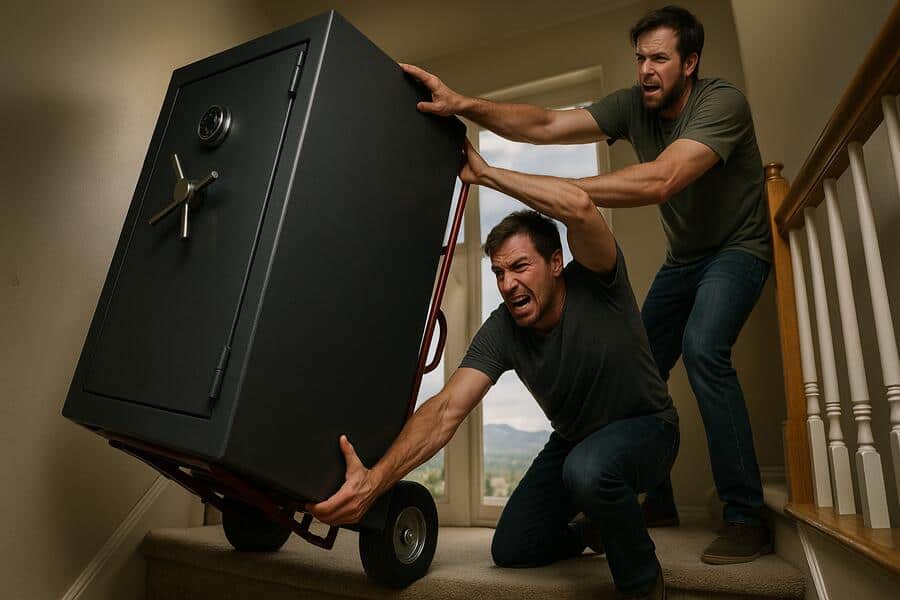
Moving a gun safe is a task that often prompts the question: “can you move a gun safe yourself?” While the immediate answer might be a confident “yes” for some, the reality is that the extreme weight, awkward dimensions, and potential for severe injury or property damage make it one of the most challenging items to relocate. Many safes, even smaller ones, can easily exceed the weight of several refrigerators combined.
Attempting “DIY gun safe moving” without proper equipment, planning, and assistance can lead to crushed limbs, damaged floors, or even catastrophic falls, especially when stairs are involved. This guide will detail the significant risks of “moving a safe” on your own and highlight the specialized equipment and expertise that professional gun safe movers bring to the table.
💡 Key Takeaway: Moving a gun safe yourself is highly risky due to extreme weight, awkward size, and potential for severe injury or property damage, especially on stairs.
Significant Risks of DIY Gun Safe Moving
1. Risk of Tipping, Crushing, and Injury
The sheer mass of a gun safe makes it incredibly dangerous if mishandled. Even a slight loss of control can have devastating consequences.
- Extreme Weight: Gun safes range from a few hundred pounds to well over a thousand pounds. This weight makes them inherently difficult to maneuver, especially around corners or over thresholds.
- High Center of Gravity: Many safes are taller than they are wide, giving them a high center of gravity. This makes them prone to tipping if not perfectly balanced, leading to catastrophic falls.
- Crushing Injuries: If a safe tips, it can easily crush limbs, feet, or anything in its path. These types of injuries are often severe, resulting in broken bones, lacerations, or worse.
- Awkward Handling: Safes lack convenient handles, making them difficult to grip and steer. This often leads to improvising with straps or ropes, which can slip or break under extreme load.
“DIY gun safe moving” often underestimates these dangers until it’s too late.
2. Property Damage and Floor Integrity
Your home’s structure and finishes are also at significant risk when moving a heavy safe.
- Floor Damage: The concentrated weight of a safe can easily scratch, gouge, or crack hardwood, tile, or concrete floors. Even with blankets or boards, the pressure exerted by a narrow safe bottom can be immense.
- Structural Stress: In older homes or those with weaker subflooring, the static weight of a large safe, let alone the dynamic forces of moving it, can stress floor joists and even compromise structural integrity.
- Wall and Doorway Impacts: Navigating tight hallways, doorways, and turns with an unwieldy safe almost inevitably leads to scuffs, dents, and holes in walls, doorframes, and banisters.
- Staircase Collapse: A staircase is designed to hold a certain amount of static weight. The dynamic load of a safe combined with multiple people can exceed this limit, leading to stair collapse and severe injury.
💡 Key Takeaway: DIY gun safe moving carries high risks of severe crushing injuries due to immense weight and high center of gravity, alongside potential for significant damage to floors, walls, and even structural components of your home.
Professional Equipment and Expertise for Safe Moving
3. Specialized Equipment Professionals Use
Professional movers don’t just use brute strength; they rely on purpose-built equipment designed for extreme loads.
- Heavy-Duty Appliance Dollies: These are far more robust than standard moving dollies, rated for 1,000 to 1,200+ pounds. They feature stronger frames, wider wheels, and integrated ratchet straps to securely fasten the safe, preventing shifting.
- Stair-Climbing Dollies: For moving safes up or down stairs, specialized stair-climbing dollies are essential. Some are manually operated with tracks or leverage systems, while others are motorized, making stair navigation significantly safer and less strenuous.
- Rigging Straps and Jacks: Professionals use industrial-grade rigging straps, sometimes combined with hydraulic jacks, to carefully lift, pivot, and maneuver safes into position without direct manual lifting.
- Floor Protection: Beyond standard moving blankets, professionals often use thick sheets of Ram Board, plywood, or specialized composite floor runners to distribute weight and protect floors along the entire moving path.
Attempting “moving a safe” without this equipment exponentially increases the danger.
4. The Importance of a Team and Communication
It’s not just about the gear; it’s also about the methodology and teamwork.
- Minimum of 3-4 People: Even with specialized equipment, moving a heavy safe typically requires a minimum of three to four strong individuals. Each person has a specific role: guiding, balancing, operating the dolly, and spotting for hazards.
- Clear Communication: Silent moving is dangerous moving. Professionals maintain constant, clear communication, calling out instructions like “tilt,” “forward,” “slow,” “hold,” and “clear” to coordinate movements and react to unexpected shifts.
- Pre-Planning the Route: Before any lifting, professionals meticulously plan the entire route, identifying tight turns, thresholds, potential pinch points, and the safest way to navigate stairs. They assess floor loads and potential obstacles.
- Controlled Movements: Rather than forcing a safe, professional movers use controlled, deliberate movements, leveraging the dolly and straps to minimize direct lifting and push-pull forces.
DIY vs. Professional Gun Safe Moving
| Aspect | DIY Approach (High Risk) | Professional Approach (Low Risk) |
|---|---|---|
| Equipment | Standard dolly, household ropes, blankets | Heavy-duty appliance dolly (1000+ lbs), stair-climbing dolly, ratchet straps, specialized floor protection |
| Personnel | 2-3 friends/family, potentially inexperienced | 3-4 trained, experienced movers, clear roles |
| Planning | Minimal, on-the-fly decisions | Detailed route assessment, obstacle identification, contingency plans |
| Risk of Injury | Very High (crushing, sprains, falls) | Low (with proper training and equipment) |
| Risk of Property Damage | Very High (floors, walls, stairs, safe itself) | Low (with protective measures and controlled movement) |
💡 Key Takeaway: Professionals use specialized, heavy-duty equipment like appliance dollies and stair-climbing dollies, work in coordinated teams with clear communication, and meticulously plan routes to execute safe and controlled gun safe moves.
Conclusion
So, “can you move a gun safe yourself?” Technically, perhaps, but the question should really be, “should you move a gun safe yourself?” Given the substantial risks of severe personal injury, irreparable property damage, and potential harm to the safe itself, attempting DIY gun safe moving is rarely advisable. The specialized equipment, trained personnel, and meticulous planning employed by professional movers are investments in safety and peace of mind. For such a heavy and valuable item, entrusting its relocation to experts is not just a convenience—it’s a critical safety measure.
Have questions about how to moving a safe? Reach out to our team today.
Frequently Asked Questions About Moving a Gun Safe
How much does an average gun safe weigh?
Gun safe weights vary significantly depending on size, steel gauge, fire rating, and features. Smaller safes can weigh 200-500 pounds, while medium to large residential safes commonly range from 500 to over 1,500 pounds. Larger, commercial-grade safes can exceed 2,000 pounds.
What is the biggest risk when moving a gun safe yourself?
The biggest risk is severe personal injury, specifically crushing injuries to hands, feet, or other body parts if the safe tips or falls. Back injuries from improper lifting are also very common. Property damage to floors, walls, and staircases is another significant risk.
Do I need to empty my gun safe before moving it?
Yes, absolutely. Always remove all firearms, ammunition, documents, and other contents from your gun safe before moving it. This significantly reduces the overall weight, making the safe easier (though still challenging) to move, and prevents contents from shifting and causing damage inside the safe during transit.
What kind of dolly do professionals use for gun safes?
Professionals use heavy-duty appliance dollies, often rated for 1,000-1,200 pounds or more, which are designed to handle extreme weight. For stairs, they employ specialized stair-climbing dollies. These can be manual, with unique leverage systems and tracks, or even motorized, to safely navigate steps.

