Hiring a moving company is a significant decision, and one of the most critical steps in protecting your belongings and your peace of mind is ensuring your chosen mover is legitimately licensed and adequately insured. Unfortunately, the moving industry can attract unscrupulous operators. Knowing “how to check moving company license and insurance” is your best defense against scams and shoddy service.
Many consumers confuse licensing with insurance, or misunderstand the various types of coverage a mover should carry. This guide will break down the essentials of what it means to work with “licensed and insured movers,” detailing the different types of protection, how to verify them, and what a legitimate certificate of insurance should display, allowing you to confidently select professional full service movers.
💡 Key Takeaway: Verifying a moving company’s license and insurance is crucial to protect your belongings and avoid scams. Understand the different types of coverage and how to check them.
Understanding Licensing and Basic Liability
1. Moving Company Licensing: Interstate vs. Local
Licensing requirements for moving companies vary significantly depending on whether your move crosses state lines or stays within one state.
- Interstate Moves (Crossing State Lines):
- These movers are regulated by the Federal Motor Carrier Safety Administration (FMCSA), a division of the U.S. Department of Transportation.
- Every interstate moving company must have a unique USDOT Number, which acts as their license and registration. This number allows you to look up their operating authority, safety record, and complaint history on the FMCSA’s “Protect Your Move” website.
- Without a valid USDOT number, a company cannot legally perform interstate household goods moves.
- Local Moves (Within One State):
- Intrastate moves are regulated at the state level. Requirements vary wildly, with some states having strict licensing and insurance mandates, while others have very few.
- You’ll need to check with your state’s Public Utilities Commission (PUC), Department of Transportation, or similar regulatory body to understand specific local licensing requirements. Always ask for proof of state licensing.
2. The Difference Between General Liability and Workers’ Comp
“Mover insurance” isn’t a single policy; it’s a suite of protections. Two fundamental types are General Liability and Workers’ Compensation.
- General Liability Insurance:
- This policy protects against property damage and bodily injury to third parties (not the movers’ employees) that occur during the move.
- For example, if a mover accidentally scratches your walls, dings an elevator, or if a bystander trips over equipment, general liability covers the costs.
- This is often what building management companies require movers to have, frequently asking for a Certificate of Insurance (COI) that names them as an “Additional Insured.”
- Workers’ Compensation Insurance:
- This covers medical expenses and lost wages for a moving company’s employees if they are injured on the job.
- It’s critical because if a mover is injured on your property and the company doesn’t have Workers’ Comp, you (the homeowner) could potentially be held liable for their medical bills and lost wages.
💡 Key Takeaway: Interstate movers need a USDOT Number from the FMCSA, while local movers are regulated by state authorities. Ensure your mover carries both General Liability (for third-party damage/injury) and Workers’ Compensation (for employee injuries) to protect yourself.
Cargo Valuation and Verification
3. Cargo Liability vs. Valuation Coverage for Your Belongings
Protecting your actual possessions is handled through cargo liability, often referred to as “valuation coverage.” It’s crucial to understand this differs from standard insurance.
- Cargo Liability (Valuation Coverage):
- This is the mover’s assumed liability for your goods. It is NOT insurance in the traditional sense, but rather a contractual limit of liability.
- Released Value Protection: This is the most basic, no-cost option. It typically covers your items at $0.60 per pound per article. For instance, a 10-pound laptop valued at $1,000 would only be covered for $6.00. This is minimal protection.
- Full Value Protection: This is a more comprehensive option, costing an additional fee. Under Full Value Protection, the mover is liable for the replacement value of any lost or damaged item. The specific terms can vary, so always read the details of your contract.
- Third-Party Insurance: You can also purchase separate moving insurance from a third-party insurer, which typically offers more robust coverage than a mover’s valuation options.
Always discuss your cargo protection options and costs with your mover and choose the level that best suits the value of your belongings.
4. How to Request and Verify Proof of Insurance
Asking for proof isn’t being difficult; it’s being smart. A reputable mover will readily provide this information.
- Ask Directly: When getting a quote, explicitly ask about their licensing and insurance. Request their USDOT number (if applicable) and confirmation of their General Liability, Workers’ Comp, and Cargo Liability policies.
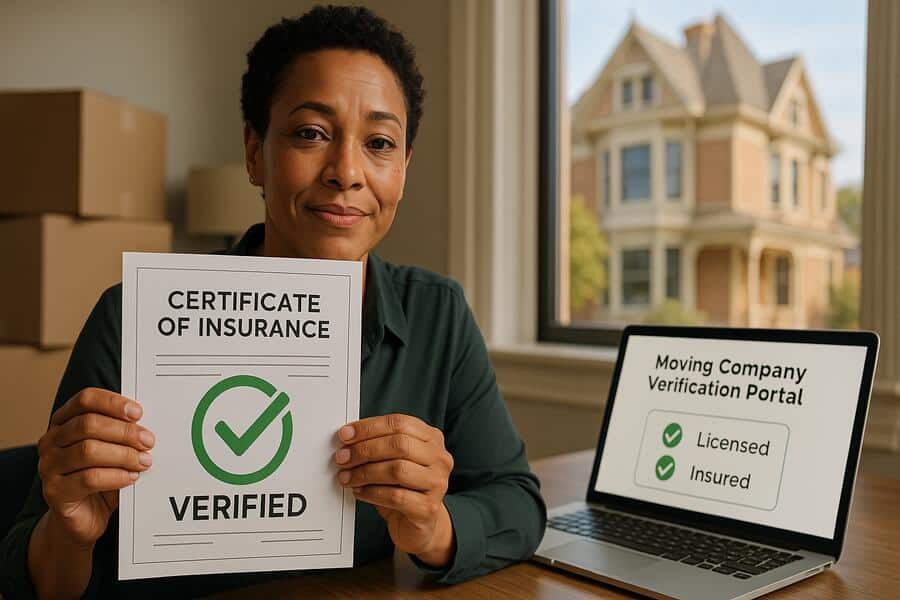
- Request a Certificate of Insurance (COI): For General Liability and Workers’ Comp, ask for a Certificate of Insurance (COI) from their insurance provider. This document will list the types of coverage, policy limits, policy numbers, and effective dates. For building requirements, the COI will also list your building as an “Additional Insured.”
- Verify Online (for Interstate Movers): Use the USDOT number to search the FMCSA’s website (protectyourmove.gov). This will show you the company’s registration status, safety ratings, and complaint history. It should also indicate their cargo and auto liability insurance filings.
- Check State Regulators (for Local Movers): If your state regulates local movers, use their provided license number to verify status with the relevant state agency.
- Read the Bill of Lading: Your Bill of Lading (the contract with the mover) should clearly outline the chosen cargo liability option and other terms. Ensure it’s fully completed and understood before signing.
Insurance & Licensing Verification Checklist
| Verification Step | What to Look For | Where to Verify |
|---|---|---|
| USDOT Number (Interstate) | Active operating authority, positive safety record. | FMCSA’s Protect Your Move |
| State License (Local) | Active registration with state regulatory body. | State PUC, DOT, or Consumer Affairs Dept. |
| General Liability | COI showing adequate coverage ($1M+ typical). | COI from mover’s insurer. |
| Workers’ Compensation | COI proving coverage for employee injuries. | COI from mover’s insurer. |
| Cargo Liability/Valuation | Clear explanation of options (Released Value vs. Full Value) in contract. | Mover’s estimate and Bill of Lading. |
💡 Key Takeaway: Request a Certificate of Insurance (COI) for liability and worker’s comp, and thoroughly review cargo valuation options. Verify USDOT numbers online for interstate moves and state licenses for local moves to ensure comprehensive protection.
Conclusion
Before entrusting your cherished possessions to a moving company, it’s paramount to “check moving company license and insurance” thoroughly. Understanding the distinct differences between licensing, general liability, workers’ compensation, and cargo valuation empowers you to make an informed decision. By diligently requesting and verifying proof of all necessary coverages, you can safeguard your move against potential financial liabilities and ensure your belongings are in the hands of legitimate, responsible professionals. Don’t let an oversight here turn your moving day into a nightmare.
Have questions about how to mover insurance? Reach out to our team today.
Frequently Asked Questions About Moving Company Licenses and Insurance
What is the difference between a moving company’s “insurance” and “valuation”?
A moving company’s “insurance” (like General Liability or Workers’ Compensation) covers damages to property or injuries to workers. “Valuation,” on the other hand, is the mover’s contractual liability for the value of your goods if they are lost or damaged. It’s not a traditional insurance policy but a limit on how much the mover is obligated to pay you, with options like Released Value (minimal) and Full Value (more comprehensive, for an extra fee).
Do I need to get additional insurance if my mover offers Full Value Protection?
It depends on your comfort level and the value of your items. Full Value Protection often covers the replacement cost of damaged goods, but it may have limitations, deductibles, or specific claim procedures. Review the mover’s Full Value Protection terms carefully. For high-value, irreplaceable items, or if you want broader coverage, purchasing a separate third-party moving insurance policy might offer greater peace of mind.
How can I find a moving company’s USDOT number?
For interstate movers, their USDOT number should be prominently displayed on their website, in their advertising, and on their moving trucks. If you can’t find it, ask them directly. Once you have the number, you can enter it into the FMCSA’s “Protect Your Move” website (www.fmcsa.dot.gov/protect-your-move) to verify their credentials.
What if my moving company doesn’t have Workers’ Compensation insurance?
If a moving company doesn’t have Workers’ Compensation insurance, you should strongly reconsider hiring them. In the event one of their employees gets injured on your property during the move, you could potentially be held financially responsible for their medical bills, lost wages, and other related costs, depending on your state’s laws. It’s a significant risk to take.