There’s nothing quite as frustrating as anticipating a new appliance delivery, only to discover on moving day that your “appliance won’t fit through the door.” This common scenario can lead to costly redelivery fees, delays, and immense stress. The key to avoiding this headache lies in meticulous pre-planning and accurate measurements. It’s not just about measuring the space where the appliance will ultimately sit; it’s about diligently mapping out the entire “appliance delivery path” from your curb to its final destination, accounting for every doorway, hallway, and turn. Many homeowners overlook crucial details, assuming standard dimensions will suffice, only to be met with an immovable obstacle.
This guide will walk you through the precise steps to “measure doorway for appliance” moves, ensuring a seamless delivery or relocation. We’ll detail how to measure doors, halls, and tight corners, and when it might be necessary to temporarily remove doors or handles to gain those critical extra inches. By following these practical tips, you can feel more confident and prepared for your large appliance movers to navigate your home successfully. Taking the time upfront to measure properly can save you a significant amount of hassle and expense down the line.
💡 Key Takeaway: To avoid the frustrating scenario of “appliance won’t fit through door,” meticulous pre-measurement of the entire “appliance delivery path” is essential. This includes knowing how to “measure doorway for appliance” dimensions accurately, as well as accounting for hallways, turns, and the appliance’s packaged size. Proper planning saves time, money, and stress on moving day.
Mapping the Appliance’s Journey
1. Measure the Appliance Itself (and its Packaging)
Before you even begin measuring your home, you need precise dimensions of the appliance.
- Appliance Dimensions: Record the height, width, and depth of the appliance. Don’t forget to account for any protruding elements like handles, hinges, or curved fronts, especially for refrigerators.
- Packaged Dimensions: Critically, appliances often arrive in bulky packaging that adds significant dimensions. Always get the packaged (boxed) dimensions from the retailer or manufacturer. This is often what needs to clear your doorways first.
- Diagonal Measurement: For especially tight spots, the diagonal measurement (from one bottom corner to the opposite top corner) can be a lifesaver. Appliances can sometimes be tilted to gain clearance, and the diagonal is the longest possible measurement of its face.
- Consider Doors (Refrigerators): For refrigerators, measure the depth with the doors removed. Many appliance movers can temporarily remove fridge doors to gain clearance.
2. The “Appliance Delivery Path”: Every Opening Counts
The biggest mistake people make is only measuring the final opening. You must measure every single point the appliance will pass through.
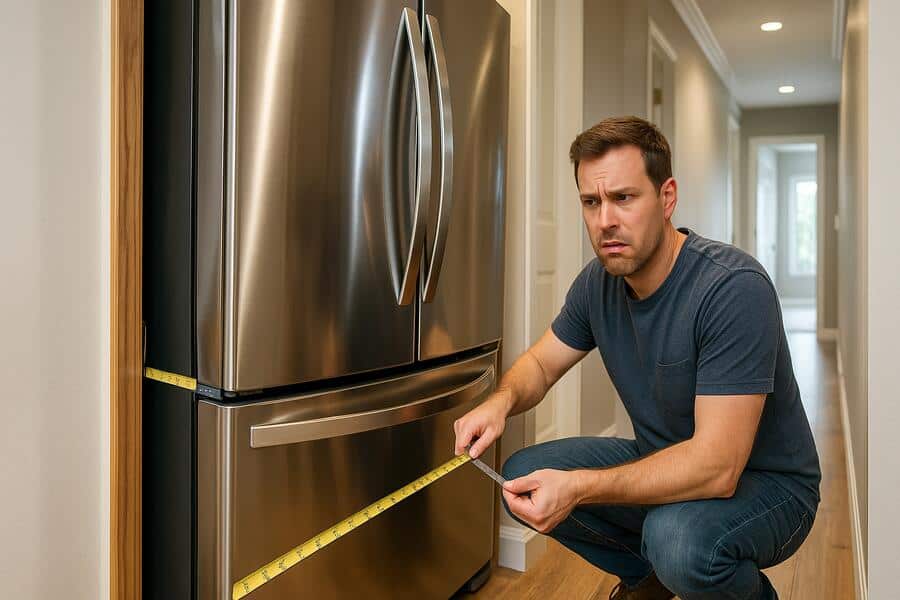
- Doorway Widths: Measure the clear opening width of every doorway along the path. Measure from the inside of the frame to the inside of the opposite frame, ensuring you account for any doorstops or hinges that reduce clearance. Measure at multiple points (top, middle, bottom) in case frames aren’t perfectly square.
- Doorway Heights: Measure the clear opening height of every doorway. This is especially important for tall items like refrigerators. Again, measure from the floor to the top of the frame.
- Hallway Widths: Measure the narrowest point of all hallways. This includes any built-in features, handrails, or wall sconces that might reduce the effective width.
- Stairwells: This is where things get tricky. Measure:
- Width: The clear width between banisters or walls.
- Height/Depth: The vertical clearance from the stair treads to the ceiling above.
- Turning Radius: Crucial for L-shaped or U-shaped staircases. Measure the landing size. Can the appliance turn without hitting the ceiling or banister?
- Elevator Clearances: If you’re in an apartment building, measure the elevator door’s clear opening width and height, and the interior depth.
- Exterior Access: Don’t forget exterior gates, narrow paths, or steps leading to your home.
💡 Key Takeaway: To successfully “measure doorway for appliance” moves, start by accurately measuring the appliance’s height, width, depth, and especially its packaged dimensions and diagonal. Then, meticulously measure the entire “appliance delivery path” including every doorway (width and height, accounting for frames), hallway, stairwell (width, height, turning radius), and elevator, always noting the narrowest clearances. This comprehensive approach prevents the frustrating “appliance won’t fit through door” scenario.
Solutions for Tight Squeezes and Final Checks
3. When Removal is Needed: Doors, Handles, and More
Sometimes, those extra few inches are all you need, and temporary modifications can make all the difference.
- Removing Interior Doors: Most interior doors are relatively easy to remove from their hinges. Simply pop out the hinge pins, and the door comes right off, providing an extra inch or two of crucial clearance.
- Removing Exterior Doors: Exterior doors are more complex due to their weight and security features but can often be removed if absolutely necessary. This is best done by someone experienced.
- Detaching Appliance Handles: For refrigerators and ovens, handles can often be unscrewed, providing another valuable inch or two of depth or width. Check your appliance manual for instructions.
- Removing Door Frames/Trim: In extreme cases, and with caution, door casings or trim can be carefully removed to gain maximum width. This should only be done if you or your movers are comfortable with minor carpentry and repairs.
- Temporary Obstacles: Clear the “appliance delivery path” of all temporary obstacles: furniture, rugs, wall hangings, plants, and anything that could impede movement or cause damage.
4. The Importance of Clearance and Professional Help
Don’t cut it too close. Always aim for a buffer.
- Allow for Clearance: Aim for at least 1-2 inches of clearance on all sides beyond the appliance’s actual dimensions (or its packaged dimensions). This accounts for human error, slight wall imperfections, and the necessary maneuvering space.
- Picture the Maneuver: Visualize how the appliance will be tilted, turned, and moved through each tight spot. Think about its weight and where the movers will need to grip it.
- Consult with Movers/Delivery Team: If you have any doubts, discuss your measurements with your appliance delivery team or professional movers beforehand. They have experience with complex moves and can offer expert advice or even conduct a pre-move survey.
- Protect Your Home: Use moving blankets, cardboard, or floor protection to safeguard walls, doorways, and floors from scuffs, dents, or scratches during the move.
Appliance Delivery Measurement Checklist
| Measurement Type | Details to Measure | Notes / Critical Advice |
|---|---|---|
| Appliance Dimensions | Height, Width, Depth (packaged & unpackaged), Diagonal. Handles ON/OFF. | Always use the largest dimension for packaged goods. Consider door removal for fridges. |
| Doorways | Clear opening Width (frame to frame) & Height (floor to frame). | Measure at multiple points. Account for doorstops/hinges. |
| Hallways | Narrowest point Width & Height (if ceilings slope/have fixtures). | Include built-ins, handrails, light fixtures. |
| Stairwells | Width between banisters/walls, Height from tread to ceiling, Landing dimensions. | Crucial for turns; visualize tilting and maneuvering. |
| Elevators | Door clear opening Width & Height, Interior Depth. | Confirm freight vs. passenger elevator capacity/rules. |
| Final Opening | Height, Width, Depth (plus ventilation/door swing space). | This is the last measurement, not the only one. |
💡 Key Takeaway: To prevent the dreaded “appliance won’t fit through door” scenario, be prepared to remove interior doors (by popping hinge pins) or appliance handles for an extra inch of clearance. In extreme cases, door frames may be removed carefully. Always aim for 1-2 inches of clearance beyond the appliance’s dimensions in the “appliance delivery path,” visualize the maneuver, and consult with professionals if unsure.
Conclusion
Successfully navigating an “appliance won’t fit through door” crisis is entirely preventable with thorough preparation. The secret lies in a comprehensive approach to “measure doorway for appliance” moves, meticulously charting the entire “appliance delivery path” from curb to final installation. By accurately measuring the appliance’s dimensions (especially packaged and diagonal), assessing every doorway, hallway, and turn, and being prepared to temporarily remove doors or handles, you empower your movers to work efficiently and safely. This upfront investment in precise measurement and planning will save you considerable time, money, and stress, ensuring your new appliance arrives in its designated spot without a hitch.
Have questions about how to measure doorway for appliance? Reach out to our team today.
Frequently Asked Questions About Measuring Doorways And Paths Before An Appliance Move
Why is it so important to “measure doorway for appliance” moves, not just the final space?
It’s crucial to “measure doorway for appliance” moves along the entire “appliance delivery path” because the appliance must fit through every single opening and turn, not just its final destination. Often, the main reason an “appliance won’t fit through door” is a narrow hallway, a tight corner, or a small elevator opening along the route, not the space itself. Overlooking any part of the path can lead to costly delays and redelivery fees.
What specific measurements do I need to take for an appliance and its path?
You need to measure the appliance’s height, width, and depth, especially its packaged dimensions, and its diagonal measurement for tilting. For the path, measure the clear opening width and height of all doorways, the narrowest width of all hallways, and the width, height, and turning radius of any stairwells or elevator openings. Always allow for 1-2 inches of clearance beyond the appliance’s dimensions.
What if my “appliance won’t fit through door” even after careful measurements?
If an “appliance won’t fit through door” even after careful measurements, you might need to make temporary modifications. This can include easily removing interior doors from their hinges, detaching appliance handles (especially for refrigerators), or in extreme cases, carefully removing door trim or even the door frame. Always clear the path of all temporary obstacles like rugs or furniture as well.
Should I measure with the appliance’s handles on or off?
Always measure the appliance’s depth with its handles on first, as this is its largest dimension. However, be prepared to measure the depth with handles removed, as many appliance handles can be unscrewed to gain an extra inch or two of crucial clearance, especially for refrigerators or ovens. This small detail can make the difference between a successful delivery and an “appliance won’t fit through door” situation.