Moving a gun safe is arguably one of the most challenging tasks in any relocation, and the complexity multiplies exponentially when stairs are involved. These robust security containers are designed to be immovable, making them exceptionally heavy and difficult to maneuver. Attempting “moving a gun safe down stairs” or up them without proper equipment, training, and a skilled crew can lead to serious injury, property damage, or even damage to the safe itself.
The specialized nature of “safe stairs moving” means it’s not a DIY project for the faint of heart. This guide will delve into the essential equipment, strategic crew positioning, and critical pre-move assessments that professional “gun safe movers” undertake to ensure a safe and efficient relocation of your heavy safe, whether it’s destined for a basement or an upper floor.
💡 Key Takeaway: Moving a gun safe up or down stairs is extremely challenging and risky due to its immense weight. It requires specialized equipment, trained personnel, and thorough pre-move planning to prevent injury or damage.
Specialized Equipment for Stair Navigation
1. Essential Stair-Climbing Equipment
Standard moving dollies are simply not built to handle the immense weight and awkward dimensions of a gun safe on stairs. Specialized equipment is crucial for “moving a gun safe down stairs” or up with control and safety.
- Heavy-Duty Appliance Dolly or Gun Safe Dolly: These are far more robust than standard hand trucks, often rated for 1,000 to 1,600 pounds or more. They feature reinforced frames, heavy-duty straps, and stair-climbing capabilities with specialized treads or wheels that grip stairs and allow for a controlled descent or ascent.
- Hydraulic Dollies or Machinery Skates: For exceptionally heavy safes (over 1,000 lbs), hydraulic dollies or machinery skates might be used on flat surfaces to get the safe to the stairs. These allow for easier manipulation of massive weights.
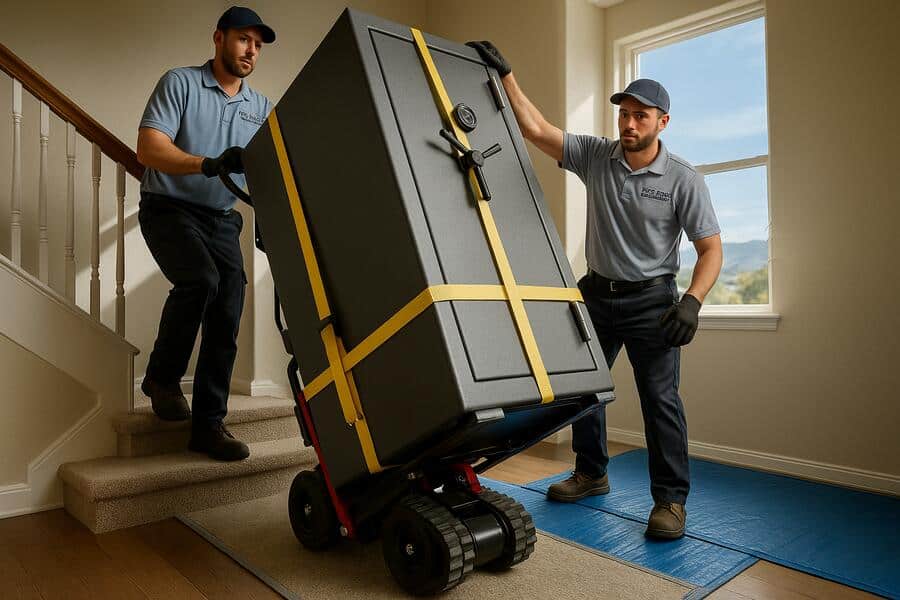
- Stair-Climbing Hand Trucks (Powered Options): The ultimate tool for “safe stairs moving” is a powered stair-climbing hand truck. These units use a motor and track system to essentially “walk” the safe up or down stairs with minimal manual effort, offering the highest degree of safety and control, especially for very steep or winding staircases.
- Moving Straps and Padded Blankets: Heavy-duty moving straps are used to secure the safe to the dolly, while thick moving blankets protect the safe’s finish and the surrounding walls, floors, and stair treads from scrapes and impacts.
2. Pre-Move Assessment: Stairs and Pathways
Before any movement begins, a thorough assessment of the environment is non-negotiable. This planning stage is critical to identify potential hazards and determine the safest approach for “moving safe to basement” or an upper floor.
- Stair Condition and Material: Movers will inspect the stairs for structural integrity. Are they solid wood, concrete, or carpeted over wood? Any loose steps, rot, or weakness must be identified. The material impacts grip and potential for damage.
- Stair Dimensions: Width, tread depth, and riser height are measured to ensure the safe and dolly can fit. Adequate clearance on both sides is vital to prevent scraping walls or losing control.
- Turns and Landings: Sharp turns, narrow landings, or intermediate landings on staircases pose significant challenges. These areas require careful planning for rotation and repositioning of the safe. Sometimes, a safe might need to be tilted to navigate tight spots.
- Doorways and Hallways: Pathways leading to and from the stairs, including doorways and hallways, must be measured and cleared. Any furniture, decor, or even door frames might need temporary removal to create sufficient clearance.
- Floor Protection: Heavy plywood, cardboard, or masonite boards are often laid down to protect floors, especially sensitive ones like hardwood, tile, or carpet, from the extreme weight and potential dragging.
💡 Key Takeaway: “Moving a gun safe down stairs” safely relies on specialized equipment like heavy-duty appliance dollies, hydraulic dollies, or powered stair climbers, along with proper padding and straps. A thorough pre-move assessment of stair condition, dimensions, turns, and pathways is essential to prevent damage and ensure a safe route.
Execution: Crew Positioning and Safety
3. Strategic Crew Positioning and Communication
The human element is just as critical as the equipment. A well-coordinated team is essential for safe “safe stairs moving.”
- Adequate Manpower: Depending on the safe’s weight and the complexity of the stairs, a crew typically consists of 2-4 experienced movers. Each person has a specific role, often with one or two guiding from the front/top and others supporting from the back/bottom.
- Weight Distribution: The safe must remain balanced on the dolly throughout the move. When ascending, more force is applied from below. When descending, more control and resistance are needed from above to prevent runaway momentum.
- Clear Communication: Constant, clear communication is paramount. Commands like “lift,” “pivot,” “slowly,” “stop,” “hold,” and “clear” ensure everyone is working in unison and aware of the next step. One person usually acts as the lead communicator.
- Spotters: At least one person often acts as a spotter, watching for clearances, obstacles, and ensuring the safe remains stable and on track.
- Personal Protective Equipment (PPE): Movers wear appropriate PPE, including gloves with good grip, steel-toed boots, and sometimes back support belts, though reliance on proper lifting technique is primary.
4. Techniques for Ascent and Descent
Whether going up or down, each direction presents unique challenges and requires specific techniques.
- Ascending Stairs: The safe is typically tilted back onto the dolly and pulled up, one stair at a time. The crew at the bottom pushes and lifts, while the crew at the top guides and stabilizes. Powered stair climbers make this much easier by doing the “walking.”
- Descending Stairs (“Moving a Gun Safe Down Stairs”): This is often considered more challenging due to the risk of the safe gaining uncontrolled momentum. The safe is again tilted onto the dolly. The crew at the top uses their weight and strength to control the descent, slowly letting the safe move down one step at a time, while the crew at the bottom ensures clearance and stability. The dolly’s stair-climbing treads or a powered unit are invaluable here for maintaining control.
- Maintaining Upright Position: Whenever possible, the safe should remain as upright as possible to maintain balance and prevent internal components from shifting. Tilting is done only as much as necessary to navigate angles.
Gun Safe Stair Moving Checklist
| Phase | Key Actions |
|---|---|
| Pre-Move Assessment |
|
| Equipment & Prep |
|
| Execution (Crew) |
|
| Technique (Stairs) |
|
💡 Key Takeaway: A skilled, communicative crew is vital. When ascending, movers push/lift from below and guide from above. When “moving a gun safe down stairs,” control is maintained from above to prevent momentum, with steady, deliberate movements and continuous communication throughout.
Conclusion
Successfully “moving a gun safe down stairs” or up them is a testament to careful planning, specialized equipment, and the coordinated expertise of a professional moving crew. This is not a task for casual movers or inadequate tools. From the initial assessment of stair condition and dimensions to the precise positioning and clear communication of the team, every detail contributes to a safe and efficient relocation. Entrusting your gun safe to professional gun safe movers is not just about convenience; it’s about protecting your property, preventing injury, and ensuring your valuable safe arrives at its destination without incident.
Have questions about how to moving a gun safe down stairs? Reach out to our team today.
Frequently Asked Questions About Moving a Gun Safe on Stairs
Is it ever safe to move a gun safe down stairs by myself?
Generally, no. Due to the extreme weight and awkward nature of gun safes, attempting to move one down stairs by yourself is highly dangerous. It poses a significant risk of severe injury, damage to the safe, and structural damage to your property. Always seek professional help for safe stair moving, especially if the safe weighs more than a few hundred pounds.
What kind of damage can happen if a gun safe is moved improperly on stairs?
Improper moving can lead to a range of issues: personal injury (back strains, crushed limbs), damage to the safe’s locking mechanism or finish, structural damage to stairs, railings, and walls, and even damage to floors if the safe falls or is dropped. Internal components of the safe, like shelving or door organizers, can also be damaged if it tips over.
Do I need to empty the gun safe before moving it?
Yes, absolutely. The gun safe should be completely emptied of all contents, including firearms, ammunition, shelving, and any other items. This not only reduces the overall weight, making it safer to move, but also prevents items inside from shifting and causing damage or throwing off the balance during transit. All firearms and ammunition should be moved separately, following all legal requirements for transport.
How do professionals protect my floors and stairs during the move?
Professional gun safe movers utilize various floor protection methods. This often includes laying down heavy-duty floor runners, plywood sheets, masonite boards, or thick moving blankets along the entire path the safe will travel, especially on sensitive flooring like hardwood, tile, or carpet. This prevents scratches, gouges, and excessive pressure points from the safe’s weight and the dolly wheels.