
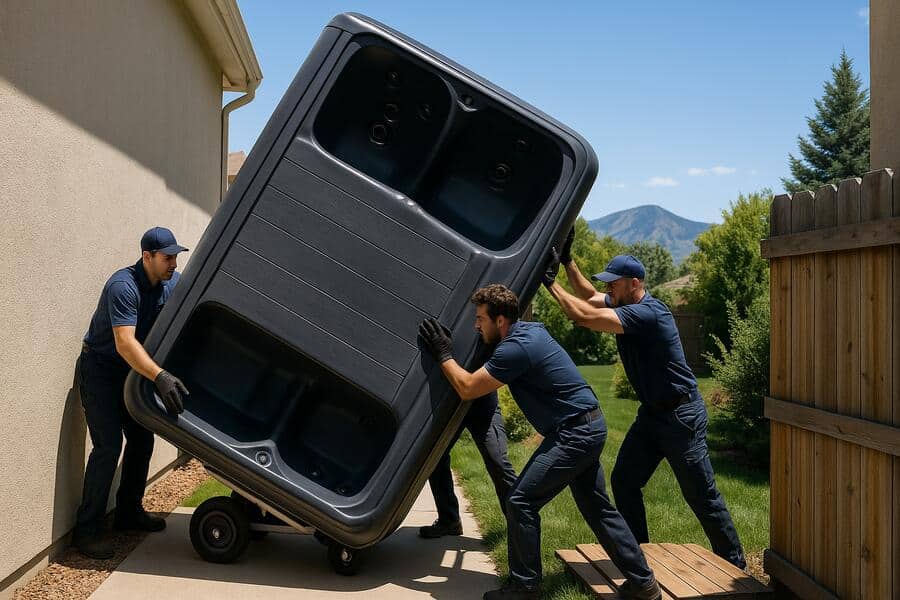
Moving a hot tub is one of the most challenging aspects of relocating, not just because of its immense weight, but often due to the tight spaces involved. Many homeowners encounter the tricky situation of “moving a hot tub through a gate” or a narrow side yard, which can quickly turn a complex task into a seemingly impossible one. Hot tubs typically range from 700 to 1,000 pounds when empty, and their bulky dimensions don’t lend themselves easily to confined pathways.
Successfully navigating these tight spots requires careful planning, specialized techniques, and often, professional expertise. This guide will walk you through the essential steps, from meticulously measuring your “hot tub access path” to the strategic maneuver of tilting the tub on its side, and even the considerations for “removing fence for hot tub” access. We’ll also address when a crane becomes not just an option, but a necessary solution. For those needing comprehensive assistance, a professional hot tub relocation service can provide invaluable support.
💡 Key Takeaway: “Moving a hot tub through a gate” or narrow side yard is challenging due to its weight and size. Critical steps include careful path measurement, tilting the tub, and potentially “removing fence for hot tub” access. Sometimes, a crane is the only viable solution.
Navigating Narrow Access Points for Hot Tub Relocation
1. Meticulously Measuring the “Hot Tub Access Path”
Before any heavy lifting begins, precise measurements are your most valuable tool. This is the first critical step when “moving a hot tub through a gate” or any constricted space.
- Hot Tub Dimensions: Measure your hot tub’s length, width, and height accurately. Remember, the height will become the width when the tub is on its side, and vice-versa. Standard hot tubs are often around 84 inches wide by 84 inches deep by 36 inches tall.
- Path Dimensions: Measure every choke point along your “hot tub access path.” This includes:
- The width of gates and doorways.
- The width and height of any side yards, alleys, or narrow passages.
- Clearance under eaves, branches, or overhead wires.
- Any steps, slopes, or uneven terrain.
- Add Buffer Room: Always add a few inches (at least 2-3) to your path measurements as a buffer. This accounts for minor inaccuracies, slight tilting during movement, and the necessity for hands-on maneuvering without scraping the tub or surroundings.
- Visual Inspection: Walk the entire route, identifying any obstacles such as air conditioning units, garden beds, tight corners, or fragile landscaping.
2. The Strategic Maneuver: Tilting the Tub On Its Side
For most standard hot tubs, tilting it on its side is the primary technique for “moving a hot tub through a gate” or a narrow side yard.
- Empty and Disconnect: Before anything, ensure the hot tub is completely drained and all electrical and plumbing connections are safely disconnected. Turn off power at the main breaker and the outdoor disconnect box.
- Specialized Equipment: This maneuver requires specialized equipment like a spa dolly (rated for 1,200+ lbs), furniture straps, and plenty of sturdy 4×4 cribbing blocks or a spa sled. Never attempt this with a standard dolly.
- The Tilt: With enough people (typically 4-6 strong individuals, even for an empty tub), the hot tub is slowly and carefully tilted onto its side. It’s crucial to have a designated leader calling out commands to ensure synchronized lifting and movement.
- Utilizing the Dolly: Once on its side, the spa dolly is slid underneath, allowing the tub to be rolled. This greatly reduces friction and makes movement possible. For incredibly narrow spaces, some professionals use rollers or slides directly under the tub’s edge.
- Protection: Use moving blankets and padding to protect the hot tub’s sides from scratches and dings during this process, especially if it will be scraping against walls or fences.
💡 Key Takeaway: When “moving a hot tub through a gate,” meticulous measurement of the “hot tub access path” is paramount, adding a few inches buffer. Tilting the fully drained and disconnected tub onto its side using a specialized spa dolly and a team of 4-6 people is the primary strategy for navigating narrow areas.
Advanced Solutions for Tricky Hot Tub Moves
3. “Removing Fence for Hot Tub” Access
If measurements confirm that your hot tub simply won’t fit, even on its side, then temporarily “removing fence for hot tub” access becomes the next viable solution.
- Fence Panel Removal: Most standard wooden fence panels can be temporarily removed by unscrewing or unbolting them from their posts. Carefully label all hardware and components for easy reinstallation.
- Gate Widening: If you have an existing gate, it might be possible to temporarily remove one of its posts or the entire gate structure to create a wider opening.
- Considerations:
- Property Lines: Ensure you are only removing fence sections on your property.
- Tools and Skill: This requires basic carpentry skills and tools. If you’re not comfortable, consider hiring a handyman for this specific task.
- Timing: Plan this carefully to minimize the time your yard is unsecured.
- Protect Surroundings: Lay down plywood or similar protection over any landscaping or delicate surfaces that might be exposed during the fence removal and hot tub movement.
4. When a Crane Becomes the Better Option
There are situations where even tilting and “removing fence for hot tub” access isn’t enough. In these cases, using a crane is often the safest and most efficient solution.
- Extreme Obstacles: If the “hot tub access path” involves multiple flights of stairs, a significant retaining wall, a multi-story balcony, or simply no ground access wide enough for the tub, a crane is necessary.
- Safety First: Attempting to force a hot tub through an impossible path risks severe injury to movers, irreversible damage to the hot tub, or destruction of property. A crane eliminates these risks by lifting the tub over obstacles.
- Professional Operation: Crane operations for hot tub moving are highly specialized and must be performed by certified, experienced crane operators. This involves a detailed risk assessment and method statement.
- Cost vs. Damage: While hiring a crane adds to the overall cost, it can be significantly less expensive than repairing a damaged hot tub, landscaping, or property, or covering medical bills for injuries.
- Pre-Move Assessment: A professional hot tub mover will conduct a thorough site assessment to determine if a crane is required, incorporating this into your moving plan and estimate.
Hot Tub Access Solutions for Narrow Paths
| Challenge | Solution | Considerations |
|---|---|---|
| Narrow Side Yard/Gate | Measure path, tilt tub on side, use spa dolly/sliders. | Requires 4-6 people, specialized dolly, protection for tub/surroundings. |
| Insufficient Gate Width | Temporarily remove fence panel(s) or widen gate opening. | Basic carpentry skills, label hardware, secure property during opening. |
| Severe Obstacles (High walls, balconies, no ground access) | Hire a professional crane service. | Higher cost, but safest and only option for complex moves; must be done by certified operators. |
💡 Key Takeaway: If the “hot tub access path” is too narrow even when tilted, consider “removing fence for hot tub” access by carefully unbolting panels. For extreme obstacles like high walls or balconies, a crane is the safest and most efficient solution, despite higher costs, preventing damage and injury.
Conclusion
“Moving a hot tub through a gate” or a narrow side yard is a common challenge that demands careful foresight and the right approach. From precise measuring and the strategic maneuver of tilting the tub on its side, to the more involved step of “removing fence for hot tub” access, each solution aims to overcome physical barriers safely. Ultimately, understanding when these ground-level solutions are insufficient and when to call in a crane is paramount. By taking these steps seriously and engaging professional hot tub movers when necessary, you can ensure your hot tub arrives at its new home without incident, ready for years of relaxation.
Have questions about how to hot tub access path? Reach out to our team today.
Frequently Asked Questions About Moving Hot Tubs Through Narrow Spaces
How many people does it take to move a hot tub?
Even an empty hot tub is extremely heavy and unwieldy. For most standard-sized hot tubs, you will need a team of at least 4-6 strong, coordinated individuals. However, attempting a DIY move without specialized equipment and experience is highly discouraged due to the significant risk of injury or damage. Professional hot tub movers typically send a crew with the right training and tools.
What equipment is essential for moving a hot tub?
Essential equipment for moving a hot tub includes a heavy-duty spa dolly (rated for at least 1,200 lbs), several strong furniture straps, 4×4 lumber or cribbing blocks for leverage and support, and moving blankets for protection. For very challenging moves, specialized pneumatic rollers, a spa sled, or even a crane may be necessary.
What should I do to prepare my hot tub before the movers arrive?
Before movers arrive, you must completely drain your hot tub. This involves turning off the power at both the main breaker and the outdoor disconnect box, then draining all water from the tub and its plumbing lines. Once drained, disconnect all electrical wiring and any gas lines (for gas-heated tubs) – this should ideally be done by a qualified electrician or plumber.
Can I move a hot tub myself to save money?
While the idea of a DIY hot tub move might seem appealing to save money, it’s strongly discouraged for most people. Hot tubs are extremely heavy, awkward, and prone to damage if not handled correctly. The risk of serious personal injury (back strains, crushed limbs) or irreversible damage to the hot tub (cracked shell, damaged plumbing, broken skirt) is very high. The cost of repairs or medical bills typically far outweighs the savings. It’s almost always a job best left to professional hot tub movers.

